Transcription Factors
see also: DNA MOTIFS
Transcription factor binding sites: several sites are available but I have not been particular impressed with the results when analyzing prokaryotic sequences
BARTweb
BARTweb (Binding Analysis for
Regulation of Transcription) - This web server is to perform BART, a
bioinformatics tool for predicting functional factors (including
transcription factors and chromatin regulators) that bind at
cis-regulatory regions to regulate gene expression in human or mouse,
taking a query gene list or a ChIP-seq dataset as input.
(Reference: Ma W et al. (2021) NAR Genom Bioinform
3(2):lqab022).
Cistrome-GO
Cistrome-GO - previously, this
group developed a widely used method, BETA, to integrate TF ChIP-seq
peaks with differential gene expression (DGE) data to infer direct target
genes. Here, we provide Cistrome-GO, a website implementation of this
method with enhanced features to conduct ontology analyses of gene
regulation by TFs in human and mouse. Cistrome-GO has two working modes:
solo mode for ChIP-seq peak analysis; and ensemble mode, which integrates
ChIP-seq peaks with DGE data.
(Reference: Li S et al. (2019) Nucleic Acids Res
47(W1): W206-W211).
Tfsitescan
Tfsitescan (Institute for Transcriptional Informatics, Pittsburgh, U.S.A.) - This tool is intended for promoter sequence analysis and works best with sequences of ~500 nt.
PlnTFDB
PlnTFDB -
Plant Transcriptional Factor Database - allows BLAST searching
(Reference: P. Pérez-Rodríguez et al. 2009 Nucl.
Acids Res. 38: D822-D872) or
here for related
site.
DBD
DBD - Transcription
factor prediction database (Gesellschaft für Biotechnologische Forschung
mbH (GBF), Braunschweig, Germany)
(Reference: D. Wilson et al. 2010. Nucl. Acids Res.
36: D88-D92)
rVista
rVista (Comparative Genomics Center, Lawrence Livermore National Laboratory, U.S.A.) - High-throughput discovery of functional regulatory elements in sequence alignments. Excluding up to 95% false positive transcription factor binding sites predictions while maintaining high sensitivity of the search.
TFmiR
TFmiR - for deep and integrative analysis of combinatorial
regulatory interactions between transcription factors, microRNAs and
target genes that are involved in disease pathogenesis.
(Reference: Hamed, M. et al. 2015. Nucl. Acids
Res.).
ISMARA
ISMARA (Integrated System
for Motif Activity Response Analysis) - is an online tool that models
genome-wide expression or ChIP-seq data, in terms of computationally
predicted regulatory sites for transcription factors (TFs) and micro-RNAs
(miRNAs). The only input required for running ISMARA is either expression
data (microarray CEL files or RNA-seq FASTQ and BED/BAM/SAM alignment
files), or ChIP-seq data (FASTQ and BED/BAM/SAM alignment files), from a
set of biological samples.
(Reference: Balwierz PJ et al. (2014) Genome Res
24(5): 869-884). Requires registration.
TRANSFAC
TRANSFAC - offers academic and non-profit organizations free access to TRANSFAC® non-professional 2005 version with much reduced functionality and content compared to our professional database. Provides access to programs including Match which is a weight matrix-based program for predicting transcription factor binding sites (TFBS) in DNA sequences. It uses a library of positional weight matrices from TRANSFAC® Public 6.0; and, P-Match - a program for predicting transcription factor binding sites (TFBS) in DNA sequences that combines pattern matching and weight matrix approaches. It uses a library of positional weight matrices from TRANSFAC® Public 6.0 along with the site alignments associated with these matrices.
PRODORIC
PRODORIC - is the most
comprehensive database about gene regulation and gene expression in
prokaryotes founded in 2003. It includes a manually curated and unique
collection of transcription factor binding sites. A variety of
bioinformatics tools for the prediction, analysis and visualization of
regulons and gene regulatory networks is available.
(Reference: Dudek, CA & Jahn, D. (2022). Nucleic
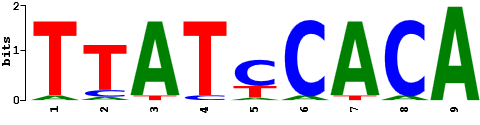
acids research, 50 (D1): D295-D302). Logo for DnaA-binding site:
LogoMotif
LogoMotif - is an
up-to-date comprehensive database on gene regulation in Actinobacteria.
It contains curated experimentally-validated transcription factor binding
site (TFBS) profiles and preconstructed position frequency matrices
(PFMs) and position weight matrices (PWMs). The matrices are pre-applied
to several model organisms to detect TFBS locations and construct gene
regulatory networks.
(Reference: Augustijn HE et l. (2023) J. Molec Biol
436(17): 168558)
JASPAR CORE
JASPAR CORE - (check tools) is an
open-access database of curated, non-redundant transcription factor
(TF)-binding profiles stored as position frequency matrices (PFMs) for
TFs across multiple species in six taxonomic groups.
(Reference: Fornes O et al. (2019) Nucleic Acids
Res. 48(D1): D87-D92).
ConTra v3
ConTra v3 -
is a tool to identify transcription factor binding sites across species.
ConTra v3 can analyze promoter regions, 5?-UTRs, 3?-UTRs and introns or
any other genomic region of interest. Thousands of position weight
matrices are available to choose from for detecting specific binding
sites.
(Reference: Kreft L et al. (2017) Nucleic Acids Res;
45(W1): W490-W494).
RegRNA 3.0
RegRNA 3.0 -
is a sophisticated meta-workflow that integrates 26 computational tools and 28 databases for annotation, enabling one-step and
customizable RNA motif predictions. RegRNA streamlines multi-step analysis and enhances result interpretation with interactive
visualizations and comprehensive reporting tools. When provided with an RNA sequence, RegRNA 3.0 generates predictions for RNA
functional motifs, RNA interaction motifs, and comprehensive RNA annotations. Specifically, RNA functional motifs include core
promoter elements, RNA decay, G-quadruplex, and 14 previous types. RNA interaction motifs include newly added RNA-ligand
interactions and RNA-binding protein predictions, along with three previous types. RNA annotation includes RNA family
classification, blood exosomes RNA, subcellular localizations, A-to-I editing events, modifications, and 3D structures, along
with four previously supported features.
(Reference: Huang Y et al. 2025. Nucleic Acids Research 53(W1): W485 - W495).
Updated: February, 2026